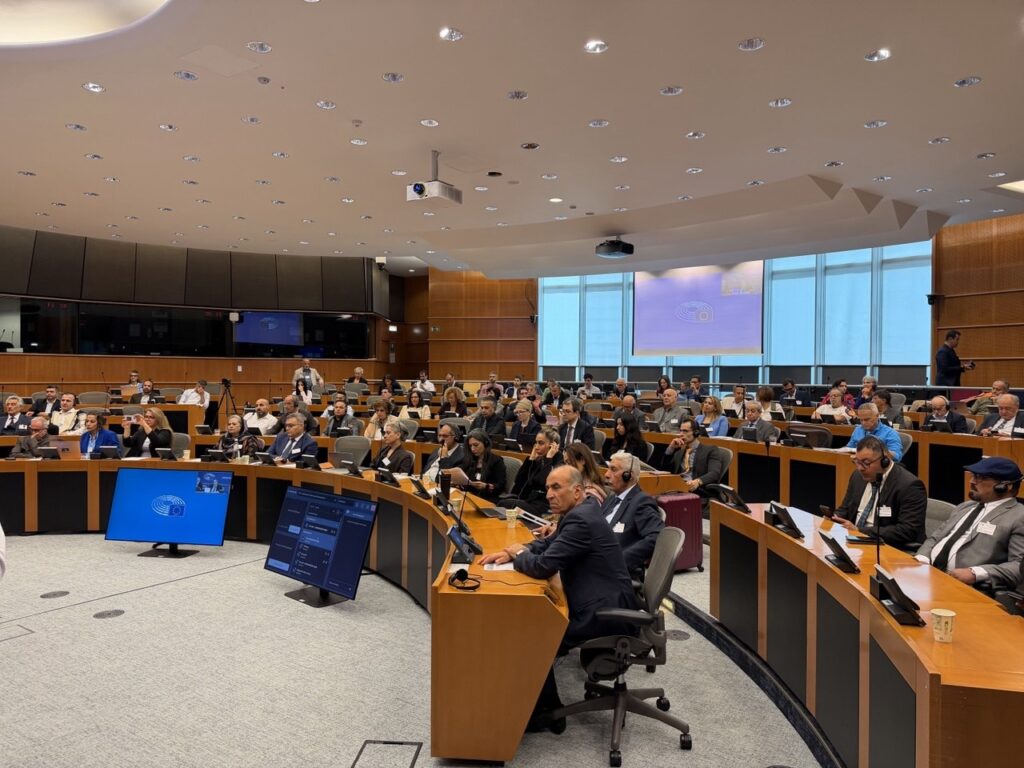
I am honoured to be here today to express my support for the construction of a democratic Iran, and for all those in Iran—women, students, workers, activists, political prisoners, and the many peoples and minorities of the country—who continue to struggle for freedom, equality, and democracy under extremely difficult conditions.
I would like to say something on a personal and political level.
For me, the Jin, Jiyan, Azadî movement has been a tremendous source of inspiration.
The courage shown by the women and youth of Iran resonated far beyond the country's borders. It resonated in Italy, it resonated across Europe, and it inspired many people who saw in that movement not only a struggle against oppression, but also a vision of a different society based on dignity, freedom, and democratic coexistence.
For many years, we in Italy have denounced the repression carried out by the Iranian regime against women, students, minorities, trade unionists, journalists, human rights defenders, and political activists.
We have stood against executions, arbitrary detention, discrimination, and the systematic denial of fundamental freedoms.
At the same time, I would like to share a more recent concern regarding the political context that has emerged after the recent Israeli and American attacks against Iran—attacks that I strongly condemn because of their imperial nature. Neither Israel nor the United States are bringing liberation to Iran. They are pursuing their own geopolitical interests, and their bombs will not bring democracy or justice to the Iranian people.
In my country, mobilizations and public debates concerning Iran have increasingly been dominated by right-wing and far-right forces.
This is happening for several reasons.
First, because large parts of the Iranian diaspora in Italy have developed close political ties with monarchist forces, particularly those associated with the son of the former Shah.
Second, because support for regime change in Iran is often framed within a broader geopolitical alignment with Israel and the United States—an alignment that right-wing forces in Italy, and across Europe, actively embrace and promote.
And third, because solidarity with the Iranian people is too often instrumentalized to advance anti-Muslim and anti-Islamic narratives that have nothing to do with democracy, human rights, or genuine solidarity.
But there is another problem that we must address honestly.
Today, it is no longer uncommon to see the flag of the Islamic Republic displayed in some demonstrations in Europe against the genocide in Palestine.
For certain sectors of the left and social movements, the Iranian regime is increasingly perceived as an anti-imperialist actor simply because it opposes Israel and the United States. From this perspective, the crimes, repression, and authoritarian nature of the regime are sometimes minimized or ignored.
I obviously do not share this position.
And I believe that both of these tendencies—the instrumentalization of the Iranian struggle by the right, and the idealization of the Iranian regime by parts of the left—ultimately weaken international solidarity with the democratic aspirations of the Iranian people.
This situation creates a difficult challenge for all of us.
As Iranian and Kurdish comrades explained during a discussion on a new internationalism that we organized yesterday here in the European Parliament with The Left Group, the democratic opposition in Iran is forced to resist on two fronts simultaneously.
On one side, there is resistance against war, foreign aggression, and imperial domination—the external threat.
On the other side, there is resistance against authoritarianism, repression, and the Islamic Republic itself—the internal threat.
To stand on both fronts at the same time is extraordinarily difficult.
It requires political clarity, courage, and consistency.
And it deserves our deepest solidarity.
Because the people fighting for democracy in Iran should not be forced to choose between dictatorship and war.
They should not be forced to choose between authoritarian rule and foreign imperialist intervention.
They should not be forced to choose between one form of oppression and another.
Our task, as democrats and internationalists, is to support a third path: a path based on self-determination, democracy, social justice, peace, and coexistence among the diverse peoples and communities of Iran.
This is why initiatives like today's conference are so important.
We need to give new energy, new visibility, and stronger international support to the project of a democratic Iran: an Iran that is free, pluralistic, democratic, and united through diversity rather than imposed uniformity; an Iran where different nations, communities, cultures, and political traditions can participate equally in shaping a common future.
I know that this is not an easy road.
But history has shown us many times that authoritarian regimes can appear strong until the day they suddenly are not.
What ultimately matters is whether democratic forces are organized, connected, visible, and supported internationally when that moment arrives.
For this reason, I want to thank all of you for your commitment, your courage, and your efforts.
And I want to conclude by expressing my full solidarity—and the solidarity of many people across Italy and Europe—with all those who continue to struggle for a democratic future for Iran.
Thank you.